
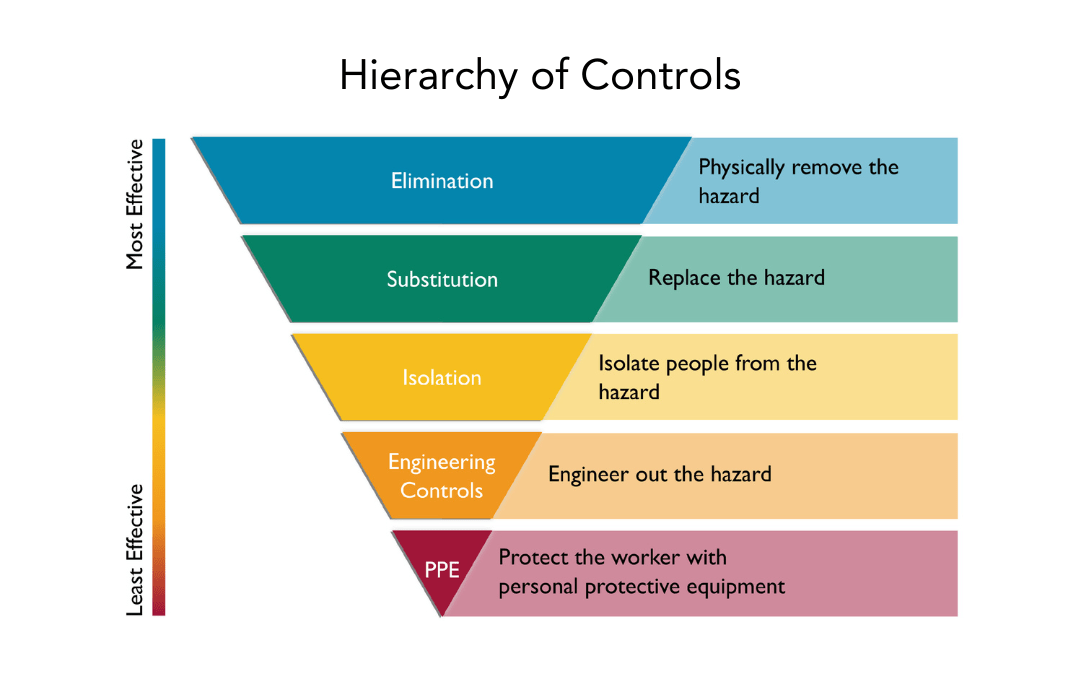
The hierarchy of controls has been an important part of the safety of the workplace for decades. It was first introduced by the National Safety Council (NSC) in the 1950s and has since become a major tool for saving workers from the dangers of work.
This guide will explain what the hierarchy is, why it is important, and how you can use it to protect people in your workplace.
What Does The Hierarchy of Controls Mean?
Hierarchy of controls is a step-by-step method for managing risks in the workplace. It helps organizations determine how to eliminate the risks by starting with the most effective solutions and at least moving towards reliable solutions.
The top of the hierarchy is far away – eliminating the complete crisis. If that is not possible, the best steps include substitute, isolation, or engineering changes that reduce the risk level.
Next in the list, you get administrative controls, such as training, rules and safe work processes. Finally, at the bottom of the hierarchy, personal protective devices (PPEs) come. PPE should be used only as the last resort because it does not eliminate the crisis – it only helps to protect the worker.
The 5 Levels of The Hierarchy of Controls Simplified
The hierarchy of controls is a step-by-step system that is used to reduce risks and protect people in the workplace. It starts with the most effective method and works at least up to the effective method. Let’s put it in simple words:
1. Elimination
Elimination means eliminating the entire crisis so that it no longer exists in the workplace. This is the best and powerful way of preventing accidents or health problems.
Example: If a piece of devices sounds too much, replacing it with a quiet machine will completely eliminate the risk.
2. Substitution
If you cannot completely eliminate a crisis, the next option is to replace the risky thing with something safe. The goal is to replace risky materials, devices or processes with something that is not a little or no risk.
Example: If cleaning causes a chemical rash, replace it with a mild, skin-friendly chemical.
3. Engineering Controls
Physical changes are made to the workplace or devices in engineering controls so that workers do not contact direct risks. Instead of eliminating or changing the crisis, the risk is reduced by design.
Example: General engineering solutions are to remove harmful smoke from the air or to add the appropriate ventilation to add machine guards.
4. Administrative Controls
Administrative controls focus on how the task is organized and operated. This means setting rules, timetables or warnings to reduce exposure to risks. It does not eliminate the crisis but reduces the possibility of damage through better practices.
Example: A person who needs to take a short break when on or use of machinery is on or use helps reduce the time when a person needs to take a short break.
5. Personal Protective Equipment (PPE)
The last level is PPE, which includes things that workers wear to protect themselves. This is the least effective control because it does not eliminate the crisis – it simply protects the worker from it. PPE is used as a backup when other restrictions are not sufficient.
Example: Safety gloves, goggles, helmets and protective clothing are all types of PPEs that protect workers from direct contact.
Benefits of Implementing a Hierarchy of Controls
Improved Workplace Safety:
The main benefit of using hierarchy of controls is safe working conditions. When the risks are administered in the phase, the risks can be eliminated or reduced to many lower levels. This reduces the opportunity for accidents or illnesses at work. Less injuries means a safe and healthy workplace for everyone.
Higher Productivity:
A safe workplace always means easy work. When accidents are prevented, employees can focus on their functions without unnecessary breaks or downtime. This helps teams to work quickly, meet the deadline, and keep productivity levels high.
Fulfilling Legal Obligations:
Each organization has a legal responsibility to protect its workers. By applying appropriate safety measures, businesses comply with health and safety laws. This reduces the risk of penalties and shows that the company takes its responsibilities seriously.
Strong Reputation:
Security companies seriously make confidence. Employees seem valuable, consumers feel confident, and partners see the organization as trusted. A strong record of workplace safety can improve the reputation and give the business edge on competitors.
Challenges of Implementing Controls
In health and safety, a common phrase “as far as practical.” This means finding the right balance between the level of risk and the cost, time, or effort required to control it.
For many businesses, control can be difficult to apply. Some solutions are expensive, it takes time to install others, and some may require big changes to work. Because of this, applying a hierarchy of control can be a difficult process, but it brings permanent advantage.
Building Safer Workplaces and a Stronger Service Culture
The way a hierarchy of control helps to create safe and more productive workplaces, strong customer service training service creates confidence and long-term success in industries. Passionate Customer Service provides interactive workshops designed for professionals in customer service travel, tourism and hospitality. With the global experience of decades, under the leadership of Shishir Nargundkar, these sessions empower participants to handle customers’ needs, manage conflict and create service excellence that repeats business and a strong reputation.